
Managing fire safety in a block of flats is different from managing a single residential property. Several households may depend on the same entrance, corridor, staircase, escape route and building-wide fire precautions. Responsibility can also be shared between a freeholder, landlord, managing agent, resident management company, Right to Manage company or another person with control of the premises.
This guide brings the main responsibilities together in one place. It explains when a fire risk assessment is required, who may be the Responsible Person, which parts of a block fall within fire safety law, what landlords and managing agents should be checking, and how the rules change for taller residential buildings.
For a more basic explanation of the assessment itself, read our guide to what a fire risk assessment for flats covers.
Fire Safety for Blocks of Flats: Quick Answer
A block of flats with common parts will normally fall within the Regulatory Reform (Fire Safety) Order 2005 in relation to those areas and other elements brought within scope by later legislation. The Responsible Person must ensure that a suitable and sufficient fire risk assessment is carried out, the relevant fire precautions are managed and maintained, findings are acted on, and required information is recorded and shared.
The Fire Safety Act 2021 clarified that the Fire Safety Order also applies to the building’s structure and external walls, including relevant attachments, and to doors between domestic premises and common parts. Since October 2023, amendments made through Section 156 of the Building Safety Act 2022 also require Responsible Persons to record the fire risk assessment in full and keep clearer records of how fire safety is managed.
| Question | Practical answer |
| Do blocks of flats need a fire risk assessment? | Where the Fire Safety Order applies, the Responsible Person must ensure a suitable and sufficient fire risk assessment is completed and kept under review. |
| Who is usually responsible? | It may be the freeholder, landlord, managing agent, RMC, RTM company or another person with control of the relevant parts. More than one Responsible Person can exist. |
| What is normally within scope? | Common parts, relevant building structure and external walls, and doors between flats and common parts. |
| Does the assessment cover inside every private flat? | The Fire Safety Order generally does not apply inside individual domestic premises, although other housing and fire-safety duties may apply. |
| Is there a fixed annual FRA renewal date? | No universal statutory interval applies to every block. The assessment must be reviewed regularly and when circumstances make a review necessary. |
| Do taller blocks have extra duties? | Yes. Buildings over 11 metres and high-rise residential buildings have additional requirements under the Fire Safety (England) Regulations 2022. |
Do Blocks of Flats Need a Fire Risk Assessment?
For blocks of flats with common parts, fire safety law places duties on the person or organisation responsible for those parts of the building. The fire risk assessment is the foundation of those duties because it identifies hazards, considers who could be harmed and determines whether the precautions already in place are adequate.
A suitable assessment should not be treated as paperwork completed simply to obtain a certificate. It should lead to a practical management process: risks are identified, priorities are assigned, remedial work is completed and fire precautions are kept under review.
The Home Office describes the fire risk assessment as a required part of complying with fire safety legislation for blocks of flats. Government guidance for small blocks also makes clear that the assessment concerns the common areas while considering wider elements of the building that fall within the amended Fire Safety Order.
If you want a more detailed answer to this specific question, read Do Blocks of Flats Need a Fire Risk Assessment?
Who Is Responsible for Fire Safety in a Block of Flats?
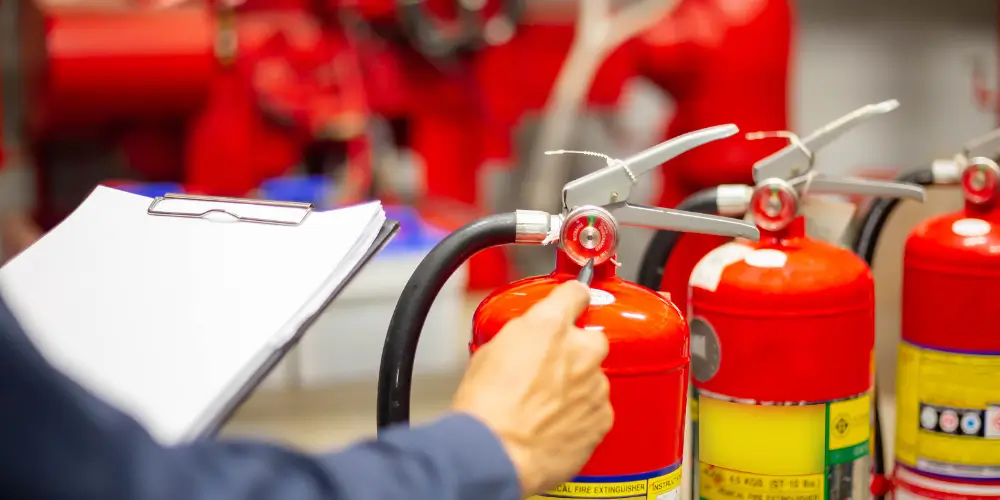
The legal term Responsible Person is important because responsibility is based on control and legal duties rather than simply on who collects the rent.
Depending on the ownership and management structure, the Responsible Person may include a landlord, freeholder, housing provider, managing agent, residents’ management company or Right to Manage company. In some buildings there can be more than one Responsible Person, each controlling a different part or carrying different duties.
This is particularly important in mixed-use buildings. For example, a residential block above shops may involve a freeholder, residential managing agent and commercial occupiers with separate responsibilities. The law requires Responsible Persons sharing a premises to identify one another, understand the extent of their responsibilities and cooperate so that the building is managed as a whole rather than as disconnected sections.
A management contract can allocate day-to-day tasks, but appointing a contractor or managing agent does not remove the need for the relevant dutyholder to make sure the required fire-safety work is actually being completed.
What Parts of a Block of Flats Are Covered?
For a typical block, attention starts with the parts used or controlled in common. These can include shared entrances, reception areas, corridors, lobbies, staircases, landings, final exits, communal rooms, meter cupboards, electrical cupboards, plant areas, bin stores, service risers and other shared spaces.
The Fire Safety Act 2021 clarified the wider scope of the Fire Safety Order for buildings containing two or more domestic premises. Relevant building structure, external walls and doors between individual flats and common parts are also within scope. This means a modern residential fire risk assessment cannot simply consider whether a communal hallway is tidy and stop there.
The inside of a private domestic flat is generally outside the Fire Safety Order itself. That does not mean fire safety inside flats is unregulated; housing legislation, tenancy duties, HMO requirements and other rules may still apply.
This distinction is important for landlords because a communal-parts fire risk assessment and a check of every hazard inside every private dwelling are not the same service.
What Should a Fire Risk Assessment Check?
The exact scope depends on the building. A small purpose-built block with one staircase does not require the same level of investigation as a multi-storey managed development, a converted property or a block with commercial premises below.
The assessment should consider how fire could start, how it could spread, who could be at risk, how residents or visitors would remain safe, and whether fire-safety precautions are suitable and properly managed.
Typical areas of attention include ignition sources, combustible storage, housekeeping, electrical risks in common areas, escape routes, final exits, fire doors, compartmentation, fire stopping, emergency lighting, alarm or detection arrangements where relevant, smoke-control systems, firefighting facilities, signage, maintenance records and information provided to residents.
The assessment should also consider whether alterations, damaged construction, service penetrations or poorly completed contractor works may have reduced the effectiveness of compartmentation.
For a detailed inspection breakdown, read what is checked during a fire risk assessment.
Fire Doors and Compartmentation in Blocks of Flats
Fire doors are particularly important in residential blocks because they help prevent fire and smoke spreading into the escape route.
Flat entrance doors can form part of the fire-resisting separation between an individual flat and the common corridor or staircase. Communal fire doors may also protect stairways, cross-corridors, electrical cupboards, service risers and other parts of the building.
The Fire Safety (England) Regulations 2022 introduced specific fire-door checking requirements for residential buildings above 11 metres in height. Communal fire doors must be checked at least every three months, while Responsible Persons must use best endeavours to check flat entrance fire doors at intervals not exceeding 12 months and record the steps taken where access cannot be obtained.
Those checks focus on matters such as whether a door self-closes effectively, whether doors and frames are damaged and whether obvious defects affect the door’s fire-safety function. A defect identified during a simple routine check can still lead to the need for competent repair, specialist investigation or replacement.
Compartmentation is equally important. Walls, floors and other fire-resisting construction are intended to restrict the spread of fire and smoke. Service penetrations, poorly sealed risers or damage caused during later works can compromise that protection. Government guidance emphasises that adequate compartmentation is fundamental to the fire strategy used in many purpose-built blocks.
Fire Safety Act 2021: What Changed for Blocks of Flats?
The Fire Safety Act 2021 was an important clarification of the Fire Safety Order.
For buildings containing two or more sets of domestic premises, it confirmed that the Order applies to the building’s structure and external walls and to doors between domestic premises and common parts. The definition of external walls can include relevant doors, windows and attachments.
For landlords and managing agents, the practical effect is that these elements should not simply be ignored because they are not part of a communal corridor.
Where there are concerns about cladding, balconies or external-wall construction, specialist appraisal may be required beyond the competence or scope of a routine fire risk assessment. The fire risk assessor should identify when additional specialist input is needed rather than make unsupported conclusions.
Fire Safety (England) Regulations 2022
The Fire Safety (England) Regulations 2022 introduced additional duties for Responsible Persons of multi-occupied residential buildings in England.
Duties Applying More Widely to Residential Buildings
Responsible Persons must provide residents with understandable fire-safety instructions. These include information on the building’s evacuation strategy, how to report a fire and what residents should do if a fire occurs.
Relevant information about fire doors must also be given to residents, including the importance of keeping fire doors shut, not interfering with self-closing devices and reporting damage or faults. This information should be given to new residents and reissued to existing residents at intervals not exceeding 12 months.
Additional Duties for Buildings Over 11 Metres
Where a residential building containing two or more domestic premises is above 11 metres, additional fire-door inspection requirements apply.
Communal fire doors require checks at least every three months and flat entrance doors require best-endeavours checks at intervals not exceeding 12 months. Records should be retained, particularly where access to a flat entrance door has not been obtained.
Additional Duties for High-Rise Residential Buildings
For the purposes of these requirements, high-rise residential buildings are generally those at least 18 metres in height or seven or more storeys.
Further duties can include providing the fire and rescue service with information on external-wall construction and building plans, maintaining a secure information box, providing suitable wayfinding signage, and conducting monthly routine checks of relevant firefighting lifts and essential firefighting equipment.
These obligations sit alongside, rather than replace, the underlying requirement to assess and manage fire risk.
Record-Keeping Duties for Landlords and Managing Agents
A major change that came into force on 1 October 2023 is that Responsible Persons must record the completed fire risk assessment in full, rather than only recording limited significant findings in certain circumstances.
Responsible Persons must also record their fire-safety arrangements and record the identity of anyone appointed to carry out or review the assessment. They must keep relevant contact information, cooperate with other Responsible Persons and pass relevant fire-safety information to an incoming Responsible Person when responsibility changes.
For a managing agent or portfolio landlord, this makes document control an important part of compliance.
A useful building file should allow someone to understand the current assessment, outstanding actions, completed remedial work, testing and maintenance history, responsible parties and resident communications without having to reconstruct the history from emails.
Information That Should Be Given to Residents
Residents should understand the fire strategy for their building and what they are expected to do if a fire occurs.
Under current requirements, relevant information can include identified risks, measures provided for resident safety, the identity and address of the Responsible Person, information about people appointed to assist with the assessment, and appropriate fire-safety instructions.
Communication should be understandable rather than simply placing a technical FRA report in a shared folder and assuming residents will interpret it themselves.
Where a building operates a stay-put strategy, residents should understand what that means. A stay-put strategy does not mean a resident is prevented from leaving. The appropriate strategy depends on the building and should be supported by its construction, compartmentation and fire-safety arrangements.
How Often Should a Fire Risk Assessment for Flats Be Reviewed?
There is no universal statutory rule saying that every block must obtain an entirely new fire risk assessment every 12 months.
The Fire Safety Order requires the assessment to be reviewed regularly and to remain up to date. A review is particularly important where there is reason to believe the existing assessment is no longer valid or where a significant relevant change has occurred.
Examples could include major alterations, changes in occupancy or management, significant fire-safety works, a serious failure of fire precautions, a fire or near miss, or information suggesting that the original assessment no longer reflects the building. Government guidance recognises annual review as good practice for small and simple premises, but the appropriate review frequency ultimately depends on the circumstances, complexity and risk of the building. For more detail on inspection time and preparation, read our guide explaining how long a fire risk assessment takes for flats.
What Happens After a Fire Risk Assessment?
The report should produce actions, not simply observations.
A useful action plan explains the problem, its priority, what should be done and who needs to take responsibility. Immediate life-safety risks should not be left until the next routine review. Some actions may be simple management improvements, such as removing combustible storage from an escape route or improving record keeping. Others may require a competent contractor, such as repairs to fire doors, emergency lighting, alarm systems, smoke control, fire stopping or other fire-protection measures.
Where the report identifies an issue outside the assessor’s specialist competence, it may recommend further investigation. Examples can include complex external-wall construction, structural fire protection or specialist smoke-control systems. Completion evidence should then be retained so the Responsible Person can demonstrate that identified actions have been followed through.
Landlord Fire Safety Checklist for Blocks of Flats
Use this as a management prompt rather than as a substitute for a building-specific fire risk assessment:
- Confirm who the Responsible Person or Responsible Persons are and document the extent of each party’s control.
- Keep the current fire risk assessment and review history readily accessible.
- Maintain a clear action tracker for recommendations and remedial work.
- Keep shared escape routes, stairs, landings and final exits appropriately managed.
- Check that fire doors and self-closing devices are maintained and that applicable statutory door checks are recorded.
- Monitor compartmentation and fire stopping, particularly after contractor works.
- Maintain emergency lighting, detection, smoke-control and other fire-safety systems where provided.
- Keep relevant service, inspection and maintenance records.
- Provide residents with the fire-safety information required for the building.
- Review the assessment when significant changes, incidents or new risks arise.
- Ensure outgoing and incoming Responsible Persons exchange relevant fire-safety information.
- Use competent contractors or specialists where the work requires expertise beyond routine building management.
Choosing a Fire Risk Assessor
The Responsible Person can carry out an assessment themselves if they genuinely have sufficient competence for the premises involved, but larger, unusual or higher-risk buildings can require significantly more knowledge and experience.
Current government guidance recommends ensuring that a person appointed to undertake the assessment has sufficient training, experience, knowledge and other qualities appropriate to the task. The Responsible Person remains responsible for ensuring that a suitable and sufficient assessment is completed.
Before appointing an assessor, provide accurate information about the building. Useful details can include the number of flats, number of storeys, building type, whether there are shared corridors or stairs, commercial premises, basements, plant areas, fire-safety systems and any previous FRA or relevant fire-safety documentation.
The more complex the building, the more important it becomes to establish the correct scope before the visit.
Further Fire Safety Guidance for Landlords
This hub is designed to give landlords, freeholders and managing agents the overall picture. More detailed questions are covered separately so each page can answer one search intent properly rather than forcing every topic into one article.
Read our detailed guides on what a fire risk assessment for flats is, whether blocks of flats need a fire risk assessment, what is checked during a fire risk assessment, and how long a fire risk assessment takes.
That structure is deliberate: this guide is the central landlord fire-safety resource, while those supporting articles answer narrower questions in greater depth.
Need a Fire Risk Assessment for a Block of Flats in London?
If you are responsible for a block of flats, converted building, HMO or residential property with shared areas in London, the first step is to confirm the appropriate assessment scope.
Send the building postcode, number of flats, number of storeys and details of any shared entrances, corridors or staircases. We can then help confirm the likely scope, price and appointment availability for a fire risk assessment for flats in London.
Frequently Asked Questions
Does every individual flat need its own fire risk assessment?
Not usually under the Fire Safety Order. For a block of flats, the assessment is concerned with the parts and building elements within the scope of the legislation rather than treating the interior of every private domestic flat as common premises. Separate housing or HMO requirements may still apply inside individual dwellings.
Can a managing agent be the Responsible Person?
Potentially. Responsibility depends on the level of control and the legal arrangements for the premises. A freeholder and managing agent may both have duties, so contracts and actual control should be reviewed rather than assuming only one organisation is responsible.
Are flat entrance doors included in a fire risk assessment?
Yes. The Fire Safety Act 2021 clarified that doors between individual flats and common parts fall within the scope of the Fire Safety Order for relevant multi-occupied residential buildings.
Do blocks below 11 metres still have fire-door duties?
Yes, fire doors can still be important fire precautions and flat entrance doors remain within the scope of the Fire Safety Order where applicable. The specific three-monthly communal-door and annual best-endeavours flat-door check regime under the Fire Safety (England) Regulations applies to buildings above 11 metres.
Is an annual fire risk assessment legally required?
Not as a universal rule for every block. Fire risk assessments must be reviewed regularly and when relevant circumstances change. Government guidance recognises annual review as good practice for small and simple premises, but review frequency should reflect the building's risk and complexity.
Need a fire risk assessment for flats in London?
Send your building details and we will help with likely scope, price and appointment availability.
Related fire safety guides
A fire risk assessment checks ignition sources, combustible materials and electrical faults. It reviews occupancy, vulnerable people and…
How Long Does a Fire Risk Assessment Take for Flats? A fire risk assessment for flats typically takes…
Yes. Landlords of blocks of flats must have a current fire risk assessment for all communal areas. The…