
How Long Does a Fire Risk Assessment Take for Flats? A fire risk assessment for flats typically takes 30 minutes to 1.5 hours on site for small, low‑rise blocks, while larger or mixed‑use buildings may require several hours, specialist checks, or multiple visits. Time varies with flat count, communal complexity, plant rooms, basements and accessibility. Experienced assessors with good documentation are quicker; detailed inspections and remedial planning extend timelines. Report drafting usually adds days. Continue for practical tips, cost guidance and steps to speed the process. availability. If you need to arrange an inspection, you can book a fire risk assessment for flats in London and confirm the expected scope, price and appointment availability.
Key Takeaways
- Typical on-site fire risk assessments for flats take about 30 minutes to 1.5 hours for a small block.
- Larger, mixed-use, or high‑risk buildings require longer inspections and staged visits, often several hours to multiple days.
- Detailed areas (plant rooms, basements, shafts, communal escape routes) add significant time to the assessment.
- Experienced assessors who use checklists complete inspections faster; less experienced assessors may need additional checks.
- Report drafting usually takes 3–7 working days, with finalization often adding another 2–5 days.
Table of Contents
Quick Answer: Typical Times for a Flat Fire Risk Assessment
How long does a typical fire risk assessment for a flat take? A straightforward assessment of a single residential flat commonly requires between 30 minutes and 1.5 hours on site. This timeframe covers visual inspection, brief occupant interviews if needed, and recording key findings. Factors that extend duration include the flat’s size, number of rooms, presence of communal systems, and accessibility challenges such as locked cupboards or loft spaces. If detailed documentation exists and basic precautions are already in place, the assessor can work more quickly. Conversely, complex layouts, evidence of hazards, or multiple appliances needing inspection add time. Travel, report writing, and administrative tasks occur separately; on-site time is the primary variable clients observe. For blocks of flats or assessments tied to multiple units, assessors schedule proportionally longer visits or multiple appointments. Clients are advised to expect modest variation and to confirm the anticipated duration when booking.

What a Basic Small-Block Assessment Covers (And Why It’s Quick)
After outlining typical on-site durations for single flats, attention shifts to what a basic assessment of a small block covers and why it can be completed quickly. A basic small-block assessment focuses on common, high-impact elements: communal escape routes, fire doors, signage, lighting, detection and alarm systems, means of compartmentation between flats, and basic management arrangements such as emergency plans and maintenance records. Inspectors usually check visible conditions rather than invasive fabric examinations, relying on sampling and resident/manager interviews to confirm procedures. Where systems are straightforward and documentation is up to date, risks can be identified and prioritised rapidly. Standard checklists and templates streamline note-taking and report generation, reducing administrative time. The limited scale, few storeys, a small number of flats and simple services mean fewer complex interfaces and less specialist testing. Consequently, a competent assessor can produce a clear, actionable report without prolonged on-site work, provided no significant defects or ambiguous records emerge.
How Time Increases for Large or Mixed-Use Buildings
Because larger or mixed-use buildings contain more occupants, complex systems and varied functions, assessments take substantially longer than for small blocks. Inspectors must coordinate with multiple stakeholders, review various occupancy types (residential, retail, offices), and examine additional fire detection suppression, and evacuation arrangements. Documentation and legal compliance checks multiply: service records, maintenance contracts and compartmentation drawings require verification.
How Long Does a Fire Risk Assessment Take for Flats? Time rises further when phasing, access constraints or live-tenancy considerations limit inspection windows. Risk evaluation becomes more granular to reflect different user behaviour and higher-consequence areas. Scheduling, travel between zones and repeated follow-ups for remedial actions add administrative hours. Ultimately, a methodical, staged approach replaces the rapid walkthrough typical for small blocks.
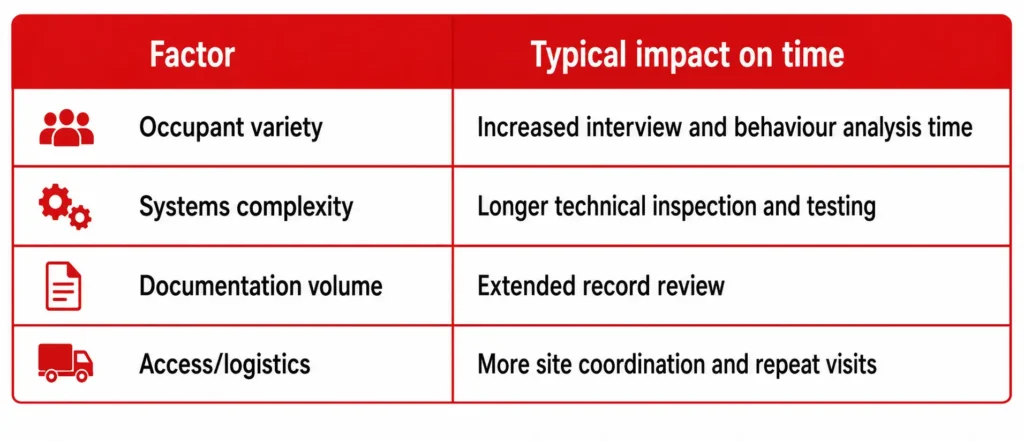
Which Building Areas Take the Longest in a Fire Risk Assessment
Which areas of a building require the most time during a fire risk assessment depends on the building’s complexity and access constraints. Commonly, communal escape routes and vertical circulation shafts require extended attention: stairwells, corridors, lift lobbies,s and service risers need detailed inspection for signage, lighting, smoke control, and obstruction risks. Plant rooms and boiler rooms also take longer because assessors examine fuel sources, ventilation, fire detection and suppression systems, and maintenance records. Storage areas, especially those with mixed or transient contents, demand thorough evaluation of combustibility and separation.
Basements and sub-floor spaces often present access and visibility challenges, increasing time spent verifying compartmentation and egress provisions. Mechanical, electrical, and telecom rooms require fire-stopping checks where services penetrate walls and floors. External walls and balconies can extend assessment time when cladding, windows and escape access are reviewed. Each of these areas involves both physical inspection and document verification, which cumulatively lengthen the overall assessment duration.
How Flat Access and In-Flat Checks Add to Assessment Time
Accessing individual flats and conducting in-flat checks significantly extend assessment time due to logistical constraints and the thoroughness required. Assessors must arrange access, wait for occupants, and follow privacy protocols; each visit involves checking escape routes, compartmentation breaches, fire doors, and obvious ignition sources. Where residents are absent, time is spent obtaining permissions or returning later, multiplying duration. Communal areas may be reviewed quickly, but in-flat inspections require methodical, room-by-room evaluation and documentation.
- Scheduling and gaining consent: coordinating times and securing entry increase travel and idle time.
- Detailed inspections: measuring door gaps, noting personal storage in corridors, and checking alarm links take focused attention.
- Re-visits and reporting: follow-up visits to clarify findings and compile individual flat notes add administrative hours.
These factors make flat-level work proportionally the largest time component in many residential assessments, especially in multi-storey blocks with numerous occupied units.
How does an assessor’s experience and scope change the assessment length?
When assessors bring greater experience and a clearly defined scope to a what a fire risk assessment for flats is, the time required typically decreases because seasoned practitioners work more efficiently, anticipate common issues, and focus effort where risk is greatest. Experienced assessors use structured checklists, pattern recognition and prior knowledge of building types to streamline inspections, reducing time spent on routine verification while maintaining thoroughness. Conversely, less experienced assessors move more slowly, require additional checks, and may need to consult guidance or supervisors, extending duration. Scope also matters: a narrow, well-scoped assignment such as confirming compartmentation and escape routes in a single flat can be completed faster than an extensive assessment covering multiple flats, systems and communal areas. Clear briefs, agreed exclusions and access arrangements prevent wasted time. Clients who set realistic scope expectations and engage competent, appropriately experienced assessors obtain reliable outcomes more quickly; however, speed should not supplant necessary diligence where risks warrant deeper investigation.

Report Writing, Remediation Planning and Follow-Up: Typical Timelines
Begin planning the report as soon as the inspection concludes: a succinct, well-structured fire risk assessment report for a single flat typically reaches draft stage within 3–7 working days, depending on assessment complexity and assessor workload. The draft will record hazards, evaluate likelihood and severity, and propose prioritized remedial actions. Finalisation follows comment, clarification and any additional evidence gathering, usually adding 2–5 working days. Where remediation requires specialist input (electrical, structural or fire-door surveys), scheduling those investigations extends timelines proportionally.
Follow-up includes issuing the final report, agreeing on remedial priorities, and arranging re-inspection or verification. Minor remedial items are often confirmed within weeks; significant works can require months, with interim control measures recommended in the report.
Typical content to expect:
- Clear executive summary with immediate actions and risk ratings.
- Detailed findings, photographs and mapped escape routes.
- Remediation plan with timescales, responsible parties and recommended verification methods.
Practical Steps Landlords and Residents Can Take to Speed Up an Assessment (And Expected UK Costs/Timeframes)
After the report timetable and remediation priorities are clarified, Fire Risk Assessment for Flats: A Complete Guide for Landlords and residents can take practical steps to accelerate assessment and reduce follow-up delays. Prepare documentation in advance: lease plans, previous assessments, maintenance records and contractor contacts. Guarantee access to all communal areas, service cupboards and individual flat entrances by issuing clear notices and arranging appointment windows. Remove temporary obstructions and label circuits or meters to speed inspections.
Designate a single point of contact for the assessor to reduce back-and-forth queries. For simple low-rise blocks, expect an assessor visit of 1–3 hours, report turnaround 2–5 working days; costs typically range from £120 to £300. Larger or higher-risk blocks may take half a day to a full day on-site, with a report of 5–14 days; costs commonly £300–£1,000+. Allow additional time and budget for remedial works such as compartmentation, signage or door upgrades; these often require contractors and can take days to weeks, with costs varying by scope.
Frequently Asked Questions
Can Tenants Perform a Basic Fire Risk Check Themselves?
They can perform a basic fire risk check: identifying obvious hazards, checking escape routes, testing alarms and noting blocked exits, but professional assessments remain necessary for legal compliance, complex risks, and remedial recommendations beyond tenant capability.
Do Shared Refurbishment Works Require a New Full Assessment?
Yes, significant shared refurbishment typically necessitates a new full assessment. The responsible party should commission a competent assessor to evaluate altered escape routes, fire separation, detection systems and communal risks, updating arrangements and documentation accordingly.
How Does Temporary Hoarding/Scaffolding Affect Assessment Validity?
Temporary hoarding or scaffolding can invalidate parts of a fire risk assessment by altering escape routes, access, and firefighting premises. The assessor notes changes, issues caveats, and recommends reassessment or interim controls until permanent conditions resume.
Are Electrically Powered Mobility Aids Considered in Evacuation Time Estimates?
Yes. The assessor accounts for electrically powered mobility aids when estimating evacuation times, considering battery weight, user assistance needs, maneuverability, charging locations, and potential entanglement; these factors can materially increase predicted evacuation durations.
Will a Partial Assessment Remain Valid After Major Tenant Turnover?
A partial assessment will likely lose validity after major tenant turnover because occupancy changes alter risks, escape routes, and vulnerabilities; reassessment or a full review is recommended to ensure that current hazards, mobility needs, and fire safety measures remain appropriate.
Conclusion
To sum up, How Long Does a Fire Risk Assessment Take for flats? A flat fire risk assessment’s duration varies with building size, complexity, and assessor scope: a basic small-block inspection can take under an hour on-site, while large or mixed-use properties, extensive in-flat checks, and detailed documentation can extend the process to several hours or multiple visits. Experienced assessors working to a focused brief deliver faster outcomes. Prompt access, prepared records, and clear remediation priorities shorten timelines and control costs, helping landlords and residents meet UK safety obligations.
Need a fire risk assessment for flats in London?
Send your building details and we will help with likely scope, price and appointment availability.
Related fire safety guides
A fire risk assessment checks ignition sources, combustible materials and electrical faults. It reviews occupancy, vulnerable people and…
Yes. Landlords of blocks of flats must have a current fire risk assessment for all communal areas. The…
Managing fire safety in a block of flats is different from managing a single residential property. Several households…